What Are Precious Metals? Types, Drivers, and Market Trading
In this article

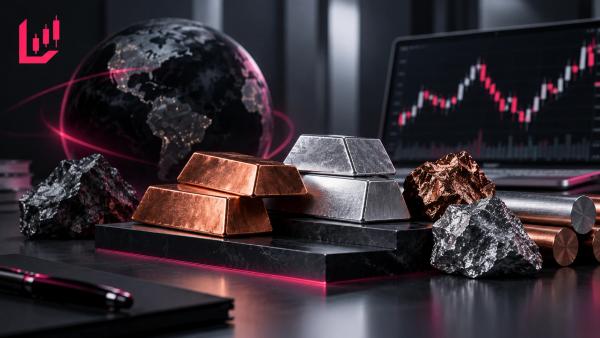
Precious metals are rare metals valued for their scarcity and financial or industrial uses. The four main types are gold, silver, platinum and palladium. Investors can own them as physical bullion, while traders can use derivatives such as CFDs to speculate on their price movements without owning the underlying metal.
Precious metals are rare metallic elements valued for their scarcity, physical properties and economic uses. They include gold, silver, platinum and palladium, which are widely used for investment, jewellery and industrial purposes.
You might hold physical precious metals as a way to preserve wealth or diversify a portfolio, or use derivatives such as Contracts for Difference (CFDs) to gain exposure to their price movements instead. Understanding what are precious metals therefore involves looking at both the metals themselves and the factors that influence their market prices.
This guide explains the main types of precious metals, what can move their prices, and the differences between owning physical bullion and trading precious metal derivatives.
Quick Takeaways
- Gold, silver, platinum and palladium are the four main precious metals traded in global financial markets.
- Precious metal prices can be influenced by factors such as real interest rates, the US dollar, industrial demand and safe-haven demand.
- Physical bullion involves ownership, storage and dealer premiums, while CFDs provide derivative exposure without physical ownership.
- CFD trading involves leverage and can incur spreads, overnight funding charges and losses if the market moves against the position.
What Are Precious Metals and What Makes Them Unique?
Precious metals differ from many base metals, such as copper, aluminium and zinc, because of their relative scarcity, economic value and resistance to corrosion. Their durability and limited supply have also contributed to their historical use as stores of value and, particularly in the case of gold and silver, as forms of money.
The precious metals meaning is not limited to investment. These metals can serve both financial and practical purposes, although the balance differs considerably from one metal to another.
- Scarcity and mining constraints: Precious metals are finite natural resources, and bringing new supply to market can require substantial investment in mining, processing and refining.
- Chemical stability: Metals such as gold and platinum are highly resistant to corrosion, helping them retain their physical properties over long periods.
- Established financial markets: Gold, silver, platinum and palladium are traded through global physical and derivatives markets.
The 4 Primary Types of Precious Metals
Four metals dominate precious metals trading: gold, silver, platinum and palladium. Each has a different balance of investment, jewellery and industrial demand. Knowing what are precious metals in practice starts with these four.

Gold (Au)
Gold is widely held as an investment asset and forms part of the reserves of many central banks. It is also used in jewellery and technology, including electronics.
Compared with total gold demand, technology represents a relatively small share. According to World Gold Council data, technology demand was about 323 tonnes in 2025, compared with total gold demand of just over 5,000 tonnes.
Gold prices can be influenced by several factors, including real interest rates, movements in the US dollar, investment flows, geopolitical uncertainty and central bank demand.
Silver (Ag)
Silver combines investment demand with substantial industrial use. Its applications include electrical and electronic products, solar photovoltaic technology, automotive components and other industrial processes.
This industrial exposure means that silver can respond to changes in both investor sentiment and economic activity. Its price can also experience larger movements than gold, although volatility varies over time and should not be treated as a fixed characteristic.
Platinum (Pt)
Platinum is a scarce precious metal with significant industrial demand. One of its major uses is in automotive catalytic converters, where it helps reduce harmful emissions. It is also used in jewellery, chemical processes and other industrial applications.
Platinum has historically been associated strongly with diesel autocatalysts, but its automotive use is not limited to diesel vehicles. Platinum can also substitute for palladium in some petrol vehicle catalytic converters.
As a result, platinum prices can be affected by automotive production, emissions standards, substitution between platinum-group metals and wider industrial conditions.
Palladium (Pd)
Palladium is another platinum-group metal with substantial automotive demand. It is widely used in catalytic converters, particularly for petrol vehicles, to help control exhaust emissions.
Mine supply is concentrated in a relatively small number of producing regions, including Russia and South Africa. This concentration can make the market sensitive to mining disruption, geopolitical developments and changes in automotive demand.
Beyond these four metals, traders looking at commodity markets may also compare precious metal price drivers with energy trading, particularly when considering how energy and other input costs affect mining and processing.
Metal | Important Value Drivers | Key Uses | Typical Market Characteristics |
|---|---|---|---|
Gold | Real rates, investment demand, central bank demand and the US dollar | Jewellery, investment and electronics | Often treated as a safe-haven asset |
Silver | Industrial and investment demand | Electronics, solar PV and other industrial applications | Can experience substantial price volatility |
Platinum | Automotive and industrial demand | Catalytic converters, jewellery and chemical applications | Sensitive to automotive and industrial conditions |
Palladium | Automotive demand and supply conditions | Primarily catalytic converters and other industrial uses | Can be sensitive to concentrated supply and automotive demand |
What Drives Precious Metal Market Prices?
Whichever metal you're looking at, its price is influenced by a combination of financial, economic and industry-specific factors. Their importance varies depending on the metal and market conditions. These forces are central to what are precious metals worth at any given time.
Real Interest Rates and Opportunity Cost
Precious metals do not generate interest or dividends simply from being held.
This creates an opportunity cost compared with interest-bearing assets. When real interest rates — broadly, nominal interest rates adjusted for inflation — rise, non-yielding assets such as gold may become relatively less attractive. Lower real rates can have the opposite effect.
However, this relationship is not mechanical. Other factors, including geopolitical risk, investment flows and currency movements, can affect prices at the same time.
US Dollar (USD) Dynamics
International precious metal benchmark prices are commonly quoted in US dollars per troy ounce.
Changes in the US dollar can therefore affect the relative cost of metals for buyers using other currencies. A stronger dollar can make dollar-denominated metals more expensive for some overseas buyers, while a weaker dollar can make them relatively cheaper.
The relationship is not guaranteed, however, as precious metal prices respond to several market forces at once.
Geopolitical Stress vs Industrial Slowdowns
Gold is often viewed as a safe-haven asset and may attract investment during periods of geopolitical or economic uncertainty. Silver can also receive investment demand, although its substantial industrial use means that it may react differently from gold.
Platinum and palladium have greater exposure to industrial and automotive demand. A slowdown in manufacturing or vehicle production can therefore place pressure on demand for these metals, although supply conditions and other factors also affect their prices.
Physical Bullion vs Precious Metal Derivatives
You can gain exposure to precious metals in different ways. Two common approaches are owning physical bullion and using derivatives such as CFDs.

Physical Bullion: Bars and Coins
Physical bullion involves buying and owning the metal itself, usually in the form of bars or coins.
- Potential advantages: The investor owns the physical asset and does not rely on a CFD provider for exposure to its price.
- Potential disadvantages: Buyers may pay a premium over the wholesale market price. Secure storage, insurance and transport may also add costs. Selling physical bullion can involve dealer spreads or other transaction costs.
Spot Metal CFDs: Derivative Contracts
A Contract for Difference (CFD) is a derivative that allows a trader to speculate on changes in a metal's price without owning or taking delivery of the underlying metal.
- Potential advantages: CFDs can provide long or short exposure and normally require only a margin deposit rather than payment for the full value of the position.
- Potential disadvantages: Leverage increases exposure to price movements and therefore magnifies both potential gains and losses. Trading also involves costs that can include spreads and overnight funding charges.
Overnight funding is particularly important when considering whether to keep a CFD position open for an extended period. The Financial Conduct Authority (FCA) has highlighted potentially significant overnight funding charges in its review of CFD providers and found that these charges were not always adequately disclosed. Traders should therefore check their provider's current funding rates and terms rather than assume that holding a metal CFD carries the same costs as owning physical bullion.
CFDs are high-risk products and are not suitable for all retail traders. UK CFD providers are required to display a standardised risk warning showing the percentage of retail investor accounts that lose money when trading CFDs with that provider. This percentage is provider-specific and can change over time.
Leverage can cause losses to accumulate quickly when prices move against a position. Spreads, overnight funding charges and slippage can also affect trading results, particularly during periods of high volatility.
Conclusion
With precious metals explained through their types, drivers and trading routes, the key point is that gold, silver, platinum and palladium combine financial and industrial roles, but the balance differs considerably between each metal — which is really the core of what are precious metals in financial markets. Their prices can respond to real interest rates, currency movements, investment demand, geopolitical uncertainty, industrial activity and supply conditions.
Physical bullion provides direct ownership but can involve dealer premiums, storage and insurance costs. CFDs provide derivative exposure without physical ownership and allow traders to take long or short positions, but leverage and ongoing trading costs create additional risks.
If you are exploring other derivative markets, what can you trade with CFDs explains how CFDs can provide exposure to markets such as indices, commodities and currency pairs.
This article is for educational purposes only and does not constitute financial advice. CFDs are complex, high-risk products, and losses can occur quickly due to leverage. Consider whether you understand how CFDs work and whether the risks are appropriate for your circumstances.
FAQ
What Are the Four Main Types of Precious Metals?
The four main precious metals traded in global financial markets are gold, silver, platinum and palladium. Gold has a strong investment and monetary role, silver combines investment and industrial demand, while platinum and palladium have significant industrial uses, particularly in automotive catalytic converters.
What Is the Main Difference Between Physical Bullion and Spot Metal CFDs?
Physical bullion gives you direct ownership of the metal but may involve dealer premiums, storage, insurance and transaction costs. Spot metal CFDs let you speculate on price movements without owning the underlying metal. However, CFDs involve leverage and can incur spreads and overnight funding charges.
Why Can Rising Real Interest Rates Put Pressure on Gold and Silver Prices?
Gold and silver do not generate interest simply from being held. When real interest rates rise, interest-bearing assets may become relatively more attractive, increasing the opportunity cost of holding precious metals. However, this relationship is not guaranteed, as metal prices are influenced by several factors at the same time.
Is Gold a Guaranteed Hedge Against Inflation?
No. Gold is often considered a potential hedge against inflation and currency uncertainty, but its price can rise or fall over shorter periods. Its performance depends on factors including real interest rates, the US dollar, investment demand and wider economic conditions.
What Overnight Costs Apply to Precious Metal CFDs?
Keeping a precious metal CFD open overnight may result in an overnight funding charge or credit, depending on the position and the provider's terms. These costs can accumulate over time, so traders should check the applicable funding rates before keeping a CFD position open for an extended period.