What Is Spread in Trading? A Beginner's Guide to Spreads
In this article

The spread is the difference between the buy and sell price of a CFD and is a cost you pay when opening a trade, so every position starts with a small unrealised loss. However, a tight or zero spread does not always mean cheaper trading, as some accounts charge separate commissions. Spreads can also widen during volatile market conditions, which may increase trading costs and the risk of slippage.
Many new traders ask what is spread in trading when they first see two prices quoted for the same asset. In trading, the spread is the difference between the buy (ask) price and the sell (bid) price of a CFD (Contract for Difference). In simple terms, it is the cost you pay to open a trade and one of the main ways brokers charge for their services.
Because of this bid-ask gap, every position starts with a small unrealised loss. The market must move in your favour by at least that amount before you reach break-even. Understanding how this cost works is important because it directly affects your trading costs and potential returns. If you overlook it, particularly when trading frequently, the drag can gradually reduce your profits and have a noticeable impact on your capital over time.
Quick Takeaways
- Every trade starts slightly in the red, as the spread is paid as soon as you open a position.
- Spread is not the only cost to look at. Some zero-spread accounts make up for it by charging higher commissions.
- Variable spreads can widen sharply during major news releases or volatile market conditions, which may increase the chance of slippage.
What Is the Bid-Ask Spread?
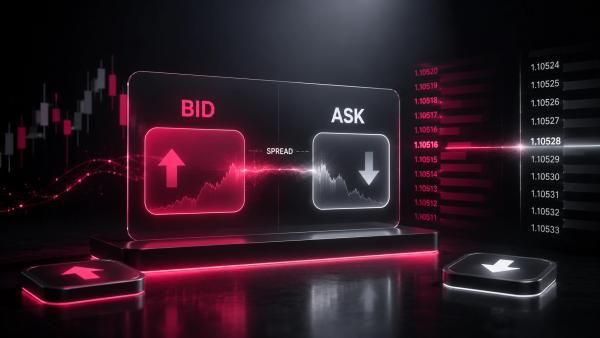
The bid-ask spread is the difference between the bid price and the ask price of a financial instrument. In most trading platforms, you will see two prices displayed at the same time rather than a single market price.
The ask price is the price at which you can buy an asset or open a long position. The bid price is the price at which you can sell an asset or open a short position. The difference between these two prices is known as the bid-ask spread, or simply the spread.
As traders buy at the ask price and sell at the bid price, the spread effectively becomes part of the cost of trading. This is one of the main ways brokers earn revenue from providing access to the market. Understanding how bid and ask prices work can also make it easier to understand why spreads change and how they affect your trading costs.
How to Calculate the Market Spread
The market spread is the difference between the bid price and the ask price. In forex and many CFD markets, the spread is normally quoted in pips or points.
For example, if EUR/USD is trading at 1.0550/1.0552, the spread is 0.0002, or 2 pips.
To work out what the spread costs, you need to know the pip value and the size of your trade. If you trade one standard lot of EUR/USD, where one pip is typically worth around $10 (this may vary by broker and lot size), a spread of 2 pips means you pay about $20 to open the position.
Knowing how pip values are calculated makes it easier to understand your trading costs and choose a position size that suits your risk tolerance.
Fixed vs Variable Spreads
Fixed spreads remain the same regardless of normal market movements, while variable spreads change in real time according to market conditions and liquidity.
With a fixed spread account, the difference between the bid and ask prices generally stays the same during normal trading hours. This makes trading costs more predictable and can make it easier to plan your trades. However, fixed spreads are often slightly wider on average because brokers need to account for periods of increased market volatility.
Variable spreads work differently. The spread can narrow during liquid market conditions and may become very tight when trading activity is high. However, spreads can widen significantly when liquidity falls or markets become more volatile, particularly during major economic announcements or periods of market uncertainty.
Spread vs Commission: The True Trading Cost
The spread is the difference between the bid and ask prices, while a commission is a separate fee charged by the broker for executing a trade. To work out the true cost of trading, you need to consider both.
Many traders look for accounts with very low or even zero spreads because they assume these accounts are automatically cheaper. However, brokers that offer zero spreads often charge a commission instead.
For example, the true cost of two accounts can look very different once commission is included:
Broker Type | Spread | Commission (per standard lot, round-turn) |
|---|---|---|
Broker A | 0.2 pips | $7 |
Broker B | 1 pip | No commission |
Which option is cheaper depends on how you trade and how often you place trades.
To compare trading accounts properly, it is important to look at all trading costs together, including the spread, commission and any overnight swap charges. This gives you a better idea of what you are actually paying to trade.
Why Do Spreads Widen?
Spreads usually widen when market liquidity falls or volatility increases. In these conditions, liquidity providers often increase the gap between the bid and ask prices to manage the additional risk.
This commonly occurs during major economic events, such as central bank interest rate decisions or the release of Non-Farm Payrolls (NFP) data. A variable spread that normally sits at around 1 pip can widen to 10 or even 15 pips within seconds.
For traders, wider spreads mean higher trading costs and a larger price movement is needed to reach break-even. They can also trigger stop-loss orders unexpectedly, particularly for short positions where the stop-loss is based on the ask price rather than the bid price.
Conclusion
The spread is one of the main costs of trading CFDs. It affects how far the market needs to move before a trade reaches break-even and can vary depending on whether your broker offers fixed or variable spreads.
However, a tight spread does not always mean lower trading costs. To understand what you are actually paying, it is important to consider all trading charges, including commissions and overnight swap fees.
If you would like to compare trading costs across different providers, our CFD broker reviews explain how spreads, commissions and other fees vary from one broker to another.
FAQ
What is a good spread for day trading?
A good spread depends on the asset and your strategy. For major forex pairs like EUR/USD, a tight spread is typically under 1 pip. However, day traders must also weigh commissions; a zero-pip spread is not "good" if it comes with heavy flat fees that destroy your profitability.
What time of day are spreads the lowest?
Spreads are usually tightest during peak market overlap hours when liquidity is at its highest. For forex and global CFDs, this is typically during the London and New York session overlap. Conversely, spreads tend to be widest during the daily rollover period or illiquid sessions.
Can a trading spread ever be zero?
Yes, some brokers offer zero-spread accounts where the bid and ask prices match perfectly under normal market conditions. However, the broker still needs to make a profit, so zero-spread accounts invariably charge a separate round-turn commission per trade to compensate for the lack of a markup.
How does leverage affect the spread?
Leverage does not change the physical gap between the bid and ask prices, but it amplifies the monetary cost of the spread. Because leverage increases your overall position size, the absolute cash amount you pay to cross the spread grows significantly compared to an unleveraged trade.
Do all trading assets have a spread?
Yes, every tradable financial instrument from forex and indices to share CFDs and commodities has a spread. As long as there is an open market with buyers and sellers, there will always be a difference between the highest price a buyer will pay and the lowest price a seller will accept.