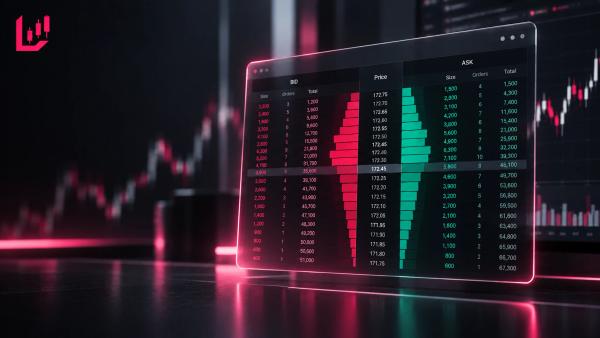
What Is Order Execution in Trading and How Does It Work?
In this article

Order execution is the mechanical process where a broker or liquidity provider matches and fills a trader's buy or sell request. Depending on whether a broker uses Direct Market Access (A-Book) or Dealing Desk execution (B-Book), orders are routed either to external institutional liquidity pools or matched internally.
Order execution is the process through which a broker or liquidity venue fills a trader’s request to buy or sell in a financial market.
When you click ‘buy’ or ‘sell’ on a trading platform, your order travels through an electronic network to a counterparty willing to take the other side of the trade. Understanding how fills work can help you assess fill speeds, understand why the executed price may differ from the quoted price, and account for trading costs such as slippage.
Quick Takeaways
- Order execution is the end-to-end process that turns a submitted trade instruction into a completed transaction.
- Market orders prioritise execution speed over price precision, while limit orders give you more control over the execution price but don't guarantee a fill.
- Direct Market Access (A-Book) routes trades to external liquidity providers, while Dealing Desk execution (B-Book) handles client trades internally.
- Execution latency and price gaps can cause slippage, which may increase total trading costs during volatile market conditions.
What Is Order Execution in Trading?
Order execution in financial markets is the completion of a buy or sell order on behalf of a trader. Submitting an order only sends an instruction to the market. Execution occurs when the order is matched with a buyer or seller and filled. In simple terms, the order execution meaning comes down to one question: does your instruction become a filled trade, and at what price?
Here is order execution explained in three distinct stages:
- Initiation: The trader selects an instrument and trade volume on the trading platform, then clicks buy or sell to send the trade request.
- Routing: The request reaches the broker’s server, which checks the account’s margin requirements and routes the order to the designated execution venue.
- Matching: The order is matched with an available counterparty in the market or an internal liquidity pool, completing the transaction and updating the trader’s account.
When you enter a trade on your platform, the price on screen is the latest available bid or ask price. But markets can move between the moment you submit the order and the moment it reaches the execution venue, so you don't always get the price you clicked. The price at which the transaction is ultimately completed is known as the executed fill price.
Depending on the broker’s infrastructure, orders may be executed through internal matching engines, external institutional market makers, or Direct Market Access (DMA) liquidity pools.
How Order Execution Works: The Trade Routing Pathway
The journey from clicking a button on your trading platform to receiving confirmation of the fill follows a four-step process:
- Order Initiation: The trader selects an instrument, volume and order type, then sends a digital request from the trading platform to the broker’s server.
- Margin & Risk Verification: The broker’s automated system checks whether the account has sufficient margin to open the position.
- Order Routing: The order is routed internally for Dealing Desk execution or forwarded externally to institutional liquidity providers for No Dealing Desk execution.
- Fill & Confirmation: A counterparty matches the order. The broker then sends confirmation back to the trader’s platform, updating the account balance and open positions.
Total execution latency is the time taken for this entire process:
Total Execution Time = Network Latency + Broker Processing Time + Venue Matching Speed
Traders generally encounter two main execution methods, depending on the platform settings and broker account type:
Execution Feature | Market Execution | Instant Execution |
|---|---|---|
Primary Priority | Speed of execution | Specific requested price |
Price Re-quotes | None (order fills at the best current market price) | Possible if the market moves during transmission (the broker offers you a new price, called a re-quote) |
Fill Guarantee | Fill is the priority, though thin liquidity can still cause partial fills or rejections; exact price is not guaranteed | Price is guaranteed; fill may be rejected |
Slippage Exposure | Subject to market slippage | Protected from slippage, but exposed to re-quote delays |
Execution Models: Dealing Desk vs. Direct Market Access
How a broker processes an order depends on whether it uses a Dealing Desk (B-Book) or Direct Market Access (A-Book) model.
Execution Model Feature | Direct Market Access (A-Book / ECN / STP) | Dealing Desk (B-Book / Market Maker) |
|---|---|---|
Order Destination | External liquidity pool (tier-1 banks, institutional ECNs) | Internal broker order book or proprietary desk |
Broker Counterparty Role | Agent passing trades directly to market participants | Principal acting as the direct counterparty to client trades |
Pricing Structure | Variable raw market spreads plus a fixed commission | Fixed or floating spreads built into the bid/ask price |
Execution Risk | Subject to market depth and external slippage | Internal risk management; potential price re-quotes |
Dealing Desk (B-Book / Market Maker)
Under a Dealing Desk model, the broker acts as the direct counterparty to your trade. When you buy, the broker sells to you from its own inventory or offsets your order against another client’s position. Spreads are often fixed or fairly tight, but your trades stay in-house rather than going to an external exchange or liquidity network.
No Dealing Desk (A-Book / ECN / STP)
No Dealing Desk brokers pass client orders through to external market participants, such as tier-1 banks, institutional prime brokers or Electronic Communication Networks (ECNs).
- Straight-Through Processing (STP): Automatically forwards trades to liquidity providers without human intervention.
- Electronic Communication Network (ECN): Matches buy and sell orders directly within an anonymous institutional liquidity pool.
Choosing between execution models involves trade-offs. Dealing Desk accounts often use commission-free pricing with fixed spreads but involve counterparty exposure. Direct Market Access accounts typically use variable market spreads plus a fixed commission per lot, offering greater visibility into market depth but with variable execution costs. How a broker routes trades also depends heavily on the specific order types selected on the trading platform.
Why Execution Quality Matters: Slippage, Gaps, and True Trading Cost
Execution speed and venue quality can directly affect the overall result of a trade. A delay of even 50 milliseconds during a high-impact economic announcement can result in an execution price that is worse than the quoted price you clicked.
Slippage is the difference between the requested price shown on your platform and the price at which the order is actually executed.
- Positive Slippage: Your order is filled at a better price than requested, such as buying at a lower price than quoted.
- Negative Slippage: Your order is filled at a worse price than requested, such as buying at a higher price than quoted.
During volatile news events or market openings, a rapid price gap can cause the market price to move past your specified order level without trading at that price. When a price gap occurs, market orders and triggered stop losses execute at the next available price in the order book rather than necessarily at the exact specified level.
In practice, many traders assess a broker mainly by its headline spreads while overlooking execution latency. A 0.2-pip spread advantage (a pip being the standard unit for small forex price moves) can quickly be wiped out if delays cause 0.5 pips of negative slippage on every entry.
Regulators such as the Financial Conduct Authority enforce best execution requirements designed to ensure brokers take all reasonable steps to achieve the best possible result when routing client trades.
Trading CFDs with leverage involves substantial financial risk. Under rules set by the Financial Conduct Authority (FCA) and the European Securities and Markets Authority (ESMA), CFD providers must disclose the share of retail accounts that lose money, and these disclosures commonly show figures of around 70% to 80%. Because market execution does not guarantee that an order will be filled at the exact submitted price, understanding latency, liquidity depth and execution routing is important when managing total trading costs.
Conclusion
Order execution is the process behind every completed trade, determining how quickly an instruction reaches the market and the price at which a position is opened or closed. Understanding how orders move through market makers, ECNs and STP systems can help you assess the trade-offs between execution speed, price precision and trading commissions.
Treating execution quality as part of the total transaction cost can also help you account for slippage and approach volatile market conditions with more realistic expectations. To understand how different trade instructions affect market entries and exits, see our guide to order types.
Trading CFDs involves the risk of losing capital, particularly when leverage is used. Order execution mechanics should therefore be treated as part of your trading and risk management education rather than as financial advice.
FAQ
What is the meaning of order execution in trading?
Order execution is the process of completing a buy or sell trade order in the financial markets. It occurs when a broker or liquidity provider receives a trader's order instruction and matches it with an opposing counterparty to fill the trade.
What is the difference between market execution and instant execution?
Market execution fills orders at the best available market price without re-quotes, though the fill price may slip during high volatility. Instant execution attempts to fill the order at the exact requested price on screen; if that price moves during transmission, the broker rejects the order or sends a re-quote.
What is the difference between A-Book and B-Book order execution?
A-Book (STP/ECN) brokers route client trade orders directly to external liquidity providers such as institutional banks. B-Book (Dealing Desk/Market Maker) brokers internalise client trades, acting as the direct counterparty and taking the opposite side of the transaction.
How does latency affect order execution quality?
Execution latency is the time delay between submitting an order instruction and receiving a fill confirmation. Higher latency increases exposure to price movement while the order is in transit, leading to negative price slippage or delayed execution.
Can order execution occur if there is no market liquidity?
No, order execution requires an opposing counterparty willing to take the other side of the trade at a given price level. In illiquid markets or during market gaps, orders may experience severe slippage or remain unfilled until matching liquidity becomes available.