What Is a Market Order?
In this article

A market order is an instruction sent to a broker to buy or sell an asset instantly at the best currently available price. It guarantees immediate entry or exit, provided there is enough liquidity, but the final execution price is not guaranteed and may suffer from slippage during high volatility.
A market order is an instruction to your broker to buy or sell an asset immediately at the best available price. It prioritises speed of execution over control of the final price.
For CFD traders, this trade-off is important. A market order allows you to enter or exit the market quickly, but the price you receive may differ from the price shown when you placed the order. This difference is known as slippage.
Slippage is more likely when markets are volatile, liquidity is low or prices are moving quickly after a major news announcement. Understanding what is a market order can help you assess your true trading costs and manage execution risk more effectively.
Quick Takeaways
- A market order is designed to execute as quickly as possible while the market is open and sufficiently liquid.
- You usually trade at the available bid or ask price, which means paying the bid-ask spread.
- The final execution price is not guaranteed and may be affected by slippage.
- Slippage can be significant during volatile market conditions or major news events.
- A stop-loss order often becomes a market order once triggered, so the closing price may differ from the level you set.
How Does a Market Order Work?
A market order is executed by matching your trade with the best available price on the opposite side of the order book.
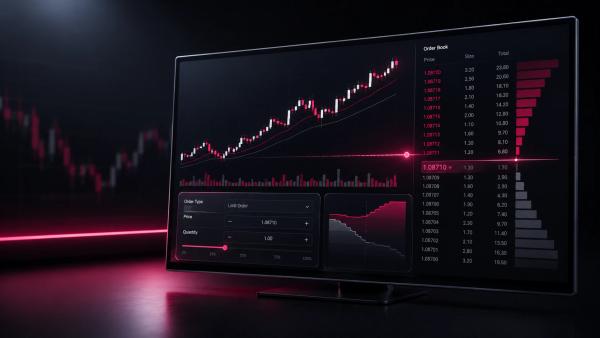
On a trading platform, you will usually see two prices: the bid and the ask. The order book is a list of buy and sell orders waiting to be matched at different price levels. When you place a market order, your trade does not join this queue. Instead, it is matched immediately with the best available order.
If you place a buy market order, you pay the current ask price. If you place a sell market order, you receive the current bid price.
The difference between these two prices is known as the bid-ask spread (also called the bid-offer spread in the UK). This is one of the main trading costs when using a market order, as you pay the spread in exchange for immediate execution.
In highly liquid markets, the spread is often small, so the cost of entering a trade is relatively low. However, in markets with lower liquidity or wider spreads, this cost can be more noticeable and may affect your position before the market price has moved.
The Hidden Cost of Speed: Slippage
Slippage is the difference between the price you see when placing a trade and the price at which your market order is actually executed.
Although market orders are designed for immediate execution, the displayed price is only the best available quote at that moment. If the market is moving quickly or liquidity is limited, that price may no longer be available when your broker processes the order. Your trade is then filled at the next available price, resulting in slippage.
Slippage is more likely during periods of heightened volatility, such as major economic announcements, central bank interest rate decisions or when markets reopen after the weekend. In these situations, prices can move rapidly between the time you place your order and when it is executed.
For example, imagine you place a buy order on a EUR/USD CFD immediately after the US Non-Farm Payrolls (NFP) report is released. Your platform displays 1.0550, but liquidity providers widen their quotes or temporarily withdraw them as the market reacts. By the time your order is executed, the best available price is 1.0555. The five-pip difference is known as negative slippage.
Because CFDs are leveraged products, even small amounts of slippage can increase your effective entry cost and alter the risk-to-reward ratio of a trade. This cost is separate from the bid-ask spread, commissions and any overnight fees that may apply if you hold a position overnight. During major economic announcements, spreads can also widen significantly, increasing the likelihood of slippage.
Because slippage often occurs during moments of high market stress, some traders may feel pressured to react quickly out of fear of missing an exit - a common behavioural bias known as loss aversion. Before using market orders on a live account, it is also worth confirming that your broker is authorised and regulated by a recognised authority, such as the FCA in the UK.
Market Order vs Limit Order
A market order prioritises execution, while a limit order prioritises price. In other words, a market order aims to execute immediately at the best available price, whereas a limit order only executes if the market reaches the price you have specified.
When comparing different order types in trading, understanding this trade-off is essential. A market order is typically used when entering or exiting a position quickly is more important than securing a specific price. For example, if a market is moving sharply against your position, a market order can help you exit without waiting for your chosen price to become available.
A limit order works differently. Instead of executing immediately, it remains in the order book until the market reaches your chosen price. This gives you greater control over your entry or exit price, but there is no guarantee that the order will be filled. If the market never reaches your specified price, the order will remain unexecuted.
Feature | Market Order | Limit Order |
|---|---|---|
Priority | Speed of execution | Control over price |
Execution price | Best available price at the time | Only at your specified price or better |
Fill guarantee | High (if there is enough liquidity) | Not guaranteed (may remain unfilled) |
Best used when | Entering or exiting quickly matters most | Getting a specific price matters most |
To learn more about how price-controlled orders work, see what is a limit order.
When Should You Use a Market Order?
Market orders are generally most suitable in highly liquid markets during normal trading hours, when spreads are typically tighter and there is plenty of available liquidity.
For example, if you are trading a major index CFD such as the S&P 500 or a major forex pair during the London–New York session overlap, a market order is more likely to be executed at or very close to the quoted price. However, the execution price is never guaranteed, and slippage can still occur.
Market orders are generally less suitable during periods of lower liquidity. This includes the daily rollover period, when liquidity often falls and spreads may widen, as well as during major economic announcements, when prices can move rapidly. In these conditions, a market order may be filled at a less favourable price than expected.
If controlling your entry or exit price is more important than immediate execution, a limit order may be a more appropriate choice. Choosing the right order type depends on your trading strategy, current market conditions and your approach to risk management.
Conclusion
Understanding what is a market order comes down to one trade-off: it is designed to execute your trade as quickly as possible, making it a useful option when speed is more important than securing a specific price. However, this convenience comes with trade-offs. You accept the current bid-ask spread, and the final execution price may differ from the quoted price if slippage occurs.
Understanding these execution costs is particularly important when trading leveraged CFDs, where even small price differences can affect your overall trading costs and the risk-to-reward profile of a trade.
If you're comparing trading costs across different providers, our CFD broker reviews examine spreads, commissions, execution quality and other key factors to help you make a more informed comparison.
FAQ
Why Did My Market Order Execute at a Different Price?
As explained above, what is a market order comes down to execution at the best available price at the time it reaches the market. If prices move quickly or liquidity is limited, the quoted price may change before your order is filled, resulting in positive or negative slippage.
Can a Market Order Be Partially Filled?
Yes. If there is not enough liquidity available at a single price level to fill your entire order, it may be executed across multiple price levels until the full order has been completed. This is more common in less liquid markets or when placing larger orders.
Can a Market Order Be Rejected?
Yes. A market order may be rejected if the underlying market is closed or suspended, if there is insufficient margin available in your account, or if the order does not meet your broker's trading requirements.
How Do Weekend Gaps Affect Market Orders?
If you place a market order while the market is closed, it will normally be executed when the market reopens. If prices have moved significantly over the weekend, your order may be filled at a substantially different price from the last quoted market price because of the gap between the previous close and the new opening price.
Does a Stop-Loss Become a Market Order?
In many CFD trading accounts, a standard stop-loss order becomes a market order once the stop price is reached. This means the final exit price is not guaranteed and may differ from your chosen stop-loss level if the market moves rapidly or gaps beyond that price.