What Is an ECN in Trading?
In this article

An Electronic Communication Network (ECN) is an automated system that matches retail CFD buy and sell orders directly with tier-1 liquidity providers. By routing trades straight to the live market, an ECN removes the broker's dealing desk from the equation, offering raw market spreads in exchange for a fixed commission per trade.
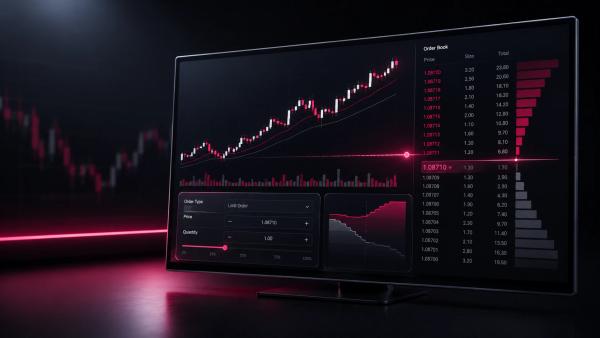
An Electronic Communication Network (ECN) - often searched as "what is ECN" or "what is an ECN" - is an automated system that matches buy and sell orders between market participants, including banks, liquidity providers, institutions and retail traders. Instead of using a traditional dealing desk, an ECN broker routes orders directly to external liquidity providers, helping to reduce potential conflicts of interest.
For CFD traders, ECN accounts are known for transparent pricing and tight, or ‘raw’, spreads. However, lower spreads do not always mean lower trading costs. Traders should also consider commission charges and the possibility of slippage or price gaps during periods of low liquidity or market volatility.
Quick Takeaways
- An ECN automatically matches buy and sell orders through a network of external liquidity providers.
- ECN trading usually avoids the traditional dealing-desk model.
- Spreads may be close to zero, but traders normally pay a separate commission.
- The total cost includes the spread, commission and any applicable overnight fees.
- Slippage and price gaps may occur when markets are volatile or liquidity is limited.
- Tight spreads do not guarantee that an order will be filled at the requested price.
How Does an ECN Work? (STP and DMA Explained)
An ECN combines price quotes from multiple liquidity providers and market participants, then automatically matches buy and sell orders at the best available price.
Instead of acting as the counterparty, the broker routes your order to a shared liquidity pool. For example, if you place an order to buy one standard lot of EUR/USD, the ECN searches for the best available seller at that moment. If market conditions change before the order is filled, the execution price may differ from the quoted price.
You will often see the terms STP (Straight Through Processing) and DMA (Direct Market Access) mentioned alongside ECN. Although they are different execution models, many retail brokers combine these technologies.
- STP means the broker sends your order directly to one or more liquidity providers without using a dealing desk.
- DMA provides direct access to market prices and, in some cases, the underlying order book.
- ECN is the electronic network that matches buy and sell orders from multiple market participants.
While these terms are often used together, they describe different aspects of how orders are routed and executed.
ECN vs Market Maker: The Core Differences
The main difference is that an ECN matches your order with other market participants, while a market maker acts as the counterparty by taking the opposite side of your trade.
This distinction affects how trades are executed and how brokers generate revenue. In a pure ECN model, the broker provides the trading infrastructure and earns income through commissions rather than taking the opposite side of client positions. This helps reduce potential conflicts of interest.
By contrast, a market maker creates liquidity internally and may act as the counterparty to client trades. If you would like to learn more about how this execution model works, see our guide on what is a market maker.
Feature | ECN | Market Maker |
|---|---|---|
Counterparty | Other traders, banks and liquidity providers | The broker |
Pricing | Raw market spreads that vary with market conditions | Broker-set spreads, which may be fixed or variable |
Fees | Separate commission, with raw spreads | Usually included within the spread |
Conflict of Interest | Generally reduced, as the broker earns commission | May exist if the broker acts as the counterparty |
The True Cost of ECN Trading: The "Zero Spread" Illusion
The total cost of trading with an ECN account includes both the raw market spread and the fixed commission charged when you open and close a position.
Many brokers advertise ECN accounts with spreads from 0.0 pips. While highly liquid currency pairs may occasionally trade at a zero spread, trading is never free. Instead of adding a mark-up to the spread, ECN brokers typically charge a fixed commission for each trade. To understand the full cost of trading, you should consider the spread, commission, overnight fees and any slippage together.
For example, suppose your broker charges a US$6 round-turn commission for one standard lot of EUR/USD, with a spread at the time of execution of 0.1 pip. The table below breaks down the total trading cost:
Cost Component | Value |
|---|---|
Commission (round-turn) | US$6 |
Spread (0.1 pip) | ≈ US$1 |
Total trading cost | ≈ US$7 (≈ 0.7 pips) |
Whether an ECN account offers better value depends on your trading style. Traders who hold positions for longer may benefit from consistently tighter spreads, while those placing a large number of small trades may find that fixed commissions account for a greater share of their overall trading costs.
Execution Risk: Slippage and Liquidity Gaps
ECN execution depends entirely on available market liquidity. If there is insufficient liquidity at your requested price, your order may be filled at the next available price, resulting in slippage.
Although ECN execution is known for providing direct market access, it also exposes traders to normal market conditions. Unlike a dealing desk, an ECN does not intervene to provide a quoted price. During major economic announcements or periods of heightened volatility, available liquidity may decrease as market participants adjust or withdraw their orders.
If you enter or exit a position during these conditions, your order may be executed several pips away from the expected price. Understanding how different order types in trading behave in low-liquidity markets can help you manage this risk more effectively.
For example, a stop-loss order in an ECN environment becomes a market order once its trigger price is reached. It is designed to close the position as quickly as possible, but the final execution price may differ from the stop-loss level if market liquidity is limited.
Conclusion
An ECN - the standard answer to "what is ECN" in modern CFD trading - gives retail traders direct access to external liquidity providers, offering transparent pricing and helping to reduce the potential conflicts of interest associated with traditional dealing desk models. In return, traders should consider the full cost of trading, including commissions, spreads and the possibility of slippage during periods of low liquidity.
Whether an ECN account is the right choice depends on your trading style, costs and approach to risk management. Before opening an account, it is worth checking that your broker holds a valid licence with a recognised regulator, such as the FCA in the UK, and cross-checking that licence number on the regulator's public register to help protect against unauthorised firms. If you are ready to compare different providers, our CFD broker reviews examine trading costs, execution quality and key account features to help you make a more informed decision.
FAQ
What Does Having an ECN Account Mean for a Retail Trader?
An ECN account allows retail traders to access prices from multiple external liquidity providers, such as banks and financial institutions. Instead of relying on a traditional dealing desk, orders are routed through an electronic network where they can be matched with available market liquidity. ECN accounts typically offer raw spreads, with a separate commission charged for each trade.
Is an ECN Better Than a Standard Market Maker Account?
Neither execution model is inherently better. The right choice depends on your trading style and priorities. ECN accounts may appeal to traders looking for transparent pricing and raw spreads, while market maker accounts may suit those who prefer simpler pricing with costs included in the spread.
How Do ECN Brokers Make Money?
ECN brokers typically earn revenue by charging a commission on each trade rather than adding a mark-up to the spread. Although pricing models vary between brokers, ECN accounts usually separate trading commissions from market spreads.
What Is the Difference Between STP and ECN?
Both STP (Straight Through Processing) and ECN route orders without using a traditional dealing desk, but they work differently. STP brokers send orders to one or more liquidity providers for execution, while an ECN matches buy and sell orders through an electronic network that connects multiple market participants.
Can ECN Brokers Manipulate Prices?
A genuine ECN broker does not set its own market prices. Instead, prices are typically sourced from external liquidity providers connected to the network. However, execution prices may still differ from quoted prices during periods of low liquidity or high market volatility due to normal market conditions.