What Is Liquidity in Trading and Why Does It Matter?
In this article

Market liquidity is the structural measurement of how easily and quickly an asset can be bought or sold at a stable price without causing a distortive shift in its valuation. In highly liquid environments, a deep volume of resting orders ensures instant matching with minimal execution friction. When this depth vanishes, spreads widen and transaction costs rise significantly.
In financial markets, liquidity refers to how easily and quickly an asset can be bought or sold at a stable price without causing a significant change in its value. A highly liquid market has deep trading volume, allowing market participants to open and close positions quickly with minimal execution friction.
For retail derivatives traders, understanding market liquidity is more than a technical exercise. It directly affects execution quality and overall trading costs. When order book depth changes, spreads may widen or narrow, transaction costs can rise, and the risk of sudden losses may increase when trading with leverage.
Quick Takeaways
- High market liquidity reduces transaction friction by ensuring there are enough buy and sell orders available at closely spaced prices.
- The bid-ask spread is the clearest visible indicator of execution costs and usually narrows when market depth is strong.
- Deep liquidity does not remove risk. During major economic announcements, available order depth can disappear quickly.
- Monitoring execution conditions is important because thin market depth can lead to price gaps and slippage.
Understanding Market Liquidity: How It Works
At its core, what is liquidity in trading comes down to one simple question: can you find a counterparty willing to trade at your price, right now? Market liquidity measures how easily an order can be matched with an opposing order at the current market price. Every transaction in a financial market requires a buyer and a seller. If you want to buy a contract at a particular price, another market participant must be willing to sell it at that price.
To understand this more clearly, imagine a busy open-air market where hundreds of traders sell identical goods. You can approach almost any stall and complete a purchase immediately at the current price because both supply and demand are strong.
Now compare this with a quiet, specialist auction for a rare item. You may need to wait hours or even days to find someone willing to accept your terms. This is similar to trading in an illiquid market, where fewer participants and lower order volumes make transactions harder to complete at the expected price.
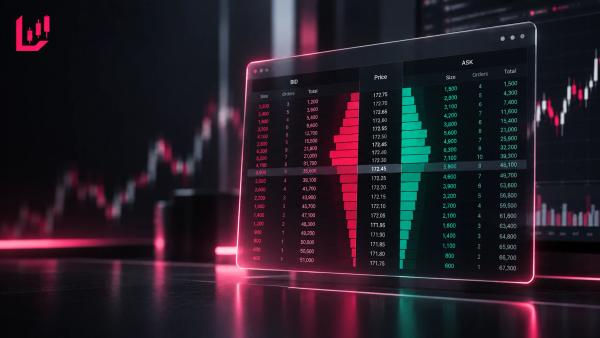
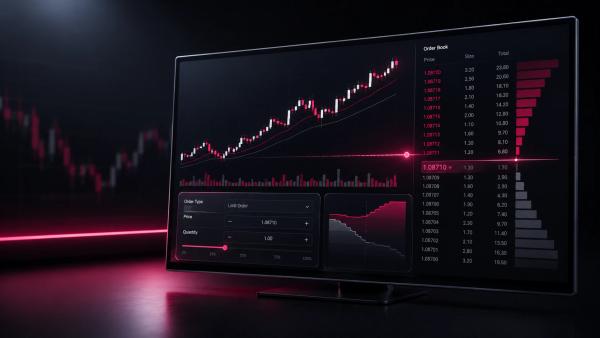
On electronic trading platforms, this matching process takes place through an order book. An order book collects limit orders, which are instructions from market participants to buy or sell at specific prices.
A deep and liquid market has substantial volumes of resting orders across small price intervals. As a result, when a market order is submitted, it is more likely to be filled quickly without moving through several less favourable price levels.
The Main Indicator: The Bid-Ask Spread
The most immediate and visible sign of market depth is the bid-ask spread, also known as the bid-offer spread.
The bid is the highest price a buyer is currently willing to pay. The ask is the lowest price a seller is currently willing to accept.
High-Liquidity Conditions
When a market has many active participants, competition usually brings the bid and ask prices closer together. This creates a tight spread, which means traders can open and close positions with lower immediate trading costs.
Low-Liquidity Conditions
When market participation falls or order book depth becomes thinner, the gap between the bid and ask prices tends to widen. A wider spread increases the cost of entering and exiting a position, as the market must move further in your favour before the trade reaches break-even.
Highly Liquid vs Illiquid Assets
Different asset classes have very different liquidity profiles, depending on their trading volumes and the number of active market participants.
The Forex market, for example, is widely reported to be the largest financial market in the world by trading volume, according to the Bank for International Settlements (BIS) Triennial Central Bank Survey. However, liquidity is not distributed evenly across all currency pairs.
Deep Markets
Major currency pairs such as EUR/USD (Euro against the US Dollar), GBP/USD (British Pound against the US Dollar) and USD/JPY (US Dollar against the Japanese Yen) benefit from continuous institutional trading activity. This creates deep liquidity pools and helps keep execution costs relatively low.
Major global equity indices also tend to attract significant institutional participation, supporting strong order book depth during the main trading sessions.
Thin Markets
Exotic currency pairs, small-cap equities and regional commodity markets typically have far fewer active participants. As a result, their order books contain fewer buy and sell orders at each price level.
In these markets, even a relatively small market order can consume all the available liquidity at the best price. Once those orders have been filled, the remaining part of the trade is executed at less favourable prices, which can lead to sharp and uneven price movements.
Execution Metric | High-Liquidity Environment | Low-Liquidity Environment |
|---|---|---|
Average Spread | Typically tight and stable | Wider, more volatile, and prone to sudden widening |
Execution Speed | Orders are usually filled almost instantly | Orders may experience delays or partial fills |
Price Movement | Prices tend to move smoothly in small increments | Prices can move abruptly, with irregular ticks and gaps |
Order Capacity | Larger orders can usually be absorbed with little market impact | Even relatively small orders can move the market price |
Why Liquidity Matters for CFD Traders
For anyone trading Contracts for Difference (CFDs), understanding market liquidity is essential because it directly affects your execution quality and overall cfd trading costs. Although retail trading platforms display a continuous stream of prices, those quotes ultimately depend on the liquidity available in the underlying market.
If you place an order that is larger than the volume available at the best bid or ask price, it cannot be filled entirely at that level. Instead, the order moves through the order book, matching with available orders at progressively less favourable prices. This means that even when the displayed spread appears tight, limited market depth can result in a poorer average execution price.
Liquidity conditions also change throughout the trading day. Around the daily interbank rollover, when banks process settlements and adjust positions, institutional liquidity in the forex market often falls for a short period. During these rollover periods, spreads commonly widen to several times their normal daytime levels, which is something I have seen catch out even experienced traders who forget to check the clock before entering a position.
Trading during these conditions can significantly increase execution costs. Reduced liquidity at this time can also affect overnight financing calculations, increasing the costs passed on to retail traders who keep positions open.
The Risks of Low Liquidity: Slippage and Price Gaps
One of the biggest risks of trading in low-liquidity conditions is slippage and price gaps. These occur when prices move rapidly from one level to another without enough orders available to fill trades at the expected prices.
This also affects how standard order types in trading behave during volatile market conditions. A common misconception among newer traders is that a stop-loss order guarantees an exit at the chosen price. In reality, a standard stop-loss instructs the platform to submit a market order once the specified price has been reached.
How Slippage Happens
Major economic announcements, such as the US Non-Farm Payrolls (NFP) report or central bank interest rate decisions, often lead liquidity providers to temporarily withdraw limit orders to reduce their own market exposure. If you have an open position during these events, the sudden reduction in available liquidity can leave significant gaps in the order book.
If the market moves beyond your stop-loss level and there are no available orders at or near that price, your trade will be executed at the next available market price instead. The difference between your intended exit price and the price at which the trade is actually filled is known as what is slippage in trading. When trading with leverage, significant slippage can increase losses beyond your planned level of risk.
Conclusion: What This Means for Your Trading Costs
Understanding what is liquidity in trading ultimately comes down to recognising how quickly and cheaply you can enter or exit a position without moving the price against yourself. Market liquidity is constantly changing and should be monitored as an important part of every trading decision. While highly liquid markets generally offer tighter spreads and more efficient execution, these conditions can change quickly during periods of heightened market volatility or major economic events.
By understanding how liquidity affects trade execution, you can better anticipate wider spreads, recognise the hidden costs of limited market depth, and choose order types that help manage execution risk.
When you're ready to compare where these costs actually land, our CFD broker reviews break down the true cost, broker by broker.
FAQ
Why is high liquidity good for trading?
High liquidity ensures there is a deep reservoir of resting buy and sell orders at close price intervals. This intense participant competition results in structurally tighter bid-ask spreads, which minimises your immediate entry and exit friction. It allows you to execute larger position volumes efficiently without sweeping through the order book and degrading your average fill price.
What does it mean if a market is illiquid?
An illiquid market suffers from a severe shortage of active buyers and sellers, leaving the electronic order book thinly populated. Because resting limit orders are sparse, even standard retail trade volumes can cause sharp, jagged price jumps. This structural thinness results in wider bid-ask spreads, higher transactional friction, and an elevated exposure to severe execution gaps.
Can high liquidity protect my trade from slippage?
No, high liquidity is dynamic and offers no permanent protection. Even structurally deep markets like major currency pairs can experience instantaneous liquidity evaporation during high-impact macroeconomic data releases. If institutional providers temporarily withdraw their resting limit orders, the order book empties out, causing defensive market orders or triggered stop-losses to incur significant slippage.
How does market depth differ from the platform spread?
The spread displayed on your platform interface only reflects the price difference between the single best bid and best offer available at that exact moment. Market depth represents the actual volume of resting limit orders waiting at secondary and tertiary price layers behind that spread. Without robust depth, a large market order will rapidly exhaust the top price level and fill at worse rates.
Why do trading spreads widen during the daily rollover?
The daily rollover represents a brief settlement window when global clearing networks and prime brokers process structural institutional accounting adjustments. During this session transition, institutional participants routinely pull their automated pricing feeds from the interbank market. This temporary reduction in baseline global volume causes order books to thin out dramatically, forcing retail spreads to expand significantly.