What Is an Order Book in Trading? Depth of Market Explained
In this article
- How Does an Order Book Work?
- What Is Depth of Market (DOM)?
- Exchange Order Books vs CFD Execution
- How Order Books Affect Trading Costs
- Iceberg Orders, Rapid Cancellations and Liquidity Traps
- Using an Order Book to Assess Execution
- Are Order Books Reliable?
- CFD Risk Warning
- Frequently Asked Questions
- Browse All Education

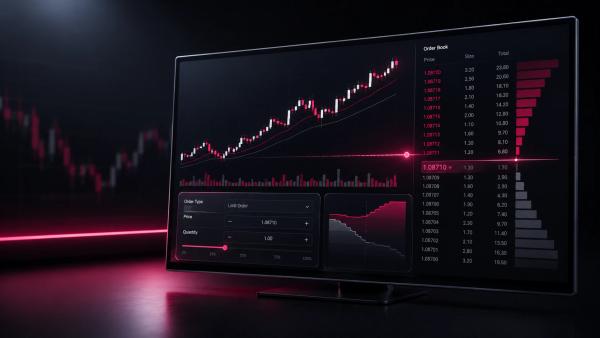
An order book is a real-time, continuously updated electronic ledger that displays open buy (bid) and sell (ask) limit orders for a financial instrument. It organises liquidity by price tier and queue order, enabling traders to assess market depth and potential execution slippage.
An order book is an electronic record of buy and sell interest for a financial instrument on a particular trading venue or platform. It usually organises orders by price level and updates as orders are added, amended, matched or cancelled.
Order books help traders assess displayed liquidity, the bid–ask spread and the amount of volume available at different prices. This can be useful when estimating potential slippage and understanding how an order might affect the market. However, the visible order book does not always show all available liquidity because some venues support hidden and iceberg orders.
Quick Takeaways
- An order book organises buy orders, or bids, and sell orders, or asks, by price and priority.
- Many venues use price and time priority, but matching rules vary between exchanges and instruments.
- Depth of Market (DOM) shows displayed liquidity at different price levels and can help traders assess potential slippage.
- Visible depth is not guaranteed to remain available because orders can be amended, cancelled or partly hidden.
- Retail CFDs are generally traded over the counter rather than through the same central order book used for the underlying exchange-traded asset.
How Does an Order Book Work?
An electronic order book has two sides: bids from buyers and asks, or offers, from sellers. Bids are normally ranked from the highest price down, while asks are ranked from the lowest price up.
The highest available bid and the lowest available ask form the best bid and offer. The difference between them is the bid–ask spread.
Bid Depth | Price Level | Ask Depth |
|---|---|---|
£100.05 | 500 units | |
£100.04 | 250 units | |
£100.03 — Best Ask | 100 units | |
200 units | £100.00 — Best Bid | |
150 units | £99.99 | |
300 units | £99.98 |
If a buyer submits a marketable order, it normally interacts first with the best available sell price. If there is not enough volume at that level, the remaining order may continue into the next price level.
Does Every Order Book Use FIFO?
No. Price–time priority, sometimes described as first-in, first-out (FIFO) at the same price, is common, but it is not universal.
For example, London Stock Exchange's Millennium Exchange uses price priority, with time priority applying within relevant order categories. It also has separate rules for hidden and iceberg liquidity.
Other markets may use different matching methods. CME Group, for example, operates products using several algorithms, including FIFO, pro-rata and combinations of the two.
This is why traders should check the matching rules of the specific venue and instrument rather than assuming that every market follows identical FIFO rules.
Understanding these mechanics also helps explain how different order types behave when you open or close a position.
What Is Depth of Market (DOM)?
Depth of Market, or DOM, shows the amount of displayed buy and sell liquidity available at different price levels around the current market price.
A deeper book has more displayed volume available across nearby prices. All else being equal, this may allow a larger order to be filled with less price movement. When depth is thin, less volume is available, so a relatively large order may need to trade across several price levels.
Suppose the best ask is £100.03 with 100 units available. If a trader submits a market buy order for 500 units, that order cannot necessarily be filled entirely at £100.03. It may consume the available 100 units before moving to higher ask prices.
The difference between the expected price and the average execution price is one form of slippage.

For traders studying order flow, changes in DOM can show where displayed buying and selling interest is concentrated. However, this should not automatically be interpreted as institutional interest or a reliable prediction of the next price movement.
Displayed liquidity can change quickly, and some available liquidity may not be visible at all.
Exchange Order Books vs CFD Execution
There is an important difference between a central exchange order book and the execution model used for most retail CFDs.
On an exchange operating a central limit order book, orders accepted by that venue interact according to its matching rules. Even then, the publicly displayed book may not reveal the full amount of liquidity. The London Stock Exchange, for example, supports both iceberg and fully hidden orders, meaning visible depth can represent only part of the liquidity available at a particular price.
UK investment firms are also subject to best-execution requirements when executing client orders. For retail clients, the FCA's rules place particular emphasis on the total consideration, including the price of the financial instrument and costs directly related to execution.
How Is CFD Execution Different?
Retail CFDs are generally traded over the counter rather than through a regulated exchange's central order book. ESMA has identified two broad CFD business models: firms that act as the client's counterparty and firms that act as intermediaries between the client and liquidity providers.
The FCA has also noted that its CFD provider portfolio primarily includes firms trading as principal to their clients at firm or group level, although business models vary.
As a result, a depth display on a CFD platform should not automatically be treated as a direct view of the underlying exchange's central order book. Depending on the provider's execution model, client trades may be internalised, hedged externally or routed through one or more liquidity providers.
This also means that a retail CFD order is not necessarily being matched directly against another retail trader's resting order.
The provider's execution policy and product documentation should explain how orders are handled.
How Order Books Affect Trading Costs
Order book depth can affect the effective cost of entering or leaving a position.
On an exchange, costs can include the bid–ask spread, broker commissions and applicable exchange or clearing charges. The exact structure depends on the market, instrument and broker.
With CFD trading, costs may include:
- the spread;
- commission, where applicable;
- an overnight fee when a position is held beyond the relevant cut-off time; and
- slippage if the available execution price changes or there is insufficient liquidity at the expected price.
This is why the quoted spread alone does not always represent the full trading costs of a position.
Iceberg Orders, Rapid Cancellations and Liquidity Traps
Visible order book depth should not be treated as a guarantee that liquidity will still be available when an order reaches the market.
Iceberg Orders
An iceberg order displays only part of its total size. Once the visible portion is executed, another portion may appear according to the venue's rules.
For example, the London Stock Exchange allows iceberg orders with a displayed peak quantity while the remaining volume stays hidden.
This means the actual amount of liquidity at a price can be greater than the quantity initially visible on the DOM.
Rapidly Changing or Cancelled Liquidity
Orders can be amended or cancelled before they execute. In fast-moving electronic markets, displayed depth may therefore change within very short periods.
A cancelled order is not automatically evidence of manipulation. The important distinction is intent. UK market-abuse rules consider whether behaviour is intended to create a false or misleading impression or induce other participants to trade.
Traders should therefore be careful with informal terms such as phantom liquidity. A disappearing liquidity wall may simply reflect legitimate order management, although deliberately deceptive order placement can raise market-manipulation concerns.
Liquidity Walls Can Give False Confidence
A large visible bid or ask may look like support or resistance, but there is no guarantee that the order will remain in the book.
The order could be filled, reduced, moved or cancelled before the market reaches it. Hidden orders may also change the amount of liquidity that is actually available.
For this reason, DOM should be treated as information about current displayed liquidity rather than a forecast of future price behaviour.
Using an Order Book to Assess Execution
An order book can help traders understand how much displayed liquidity is available and how their order size compares with that liquidity.
When assessing execution, consider the spread, the volume available near the best bid and ask, the size of your own order and whether the market is moving quickly. It is also important to remember that hidden liquidity and cancellations mean the displayed book is only a snapshot.
For CFD traders, the provider's execution model matters as well. Any depth information shown by the platform may differ from what's actually resting in the underlying market.
If you are comparing providers, our CFD broker reviews examine factors such as spreads, overnight fees and execution arrangements across different platforms.
Are Order Books Reliable?
Order books provide useful real-time information about displayed buying and selling interest, but they do not show everything happening in the market.
Hidden orders may not appear in the visible depth, displayed orders may be cancelled, and liquidity can change quickly during volatile periods. Order book data can therefore support execution analysis, but it should not be treated as a standalone signal that predicts where the market will move next.
CFD Risk Warning
CFDs are complex leveraged products and carry a high risk of rapid losses.
Under current FCA rules, UK CFD providers generally have to display their own up-to-date percentage of retail client accounts that lose money. That percentage is calculated every three months using the preceding 12-month period, rather than applying one fixed industry-wide loss rate.
For historical context, ESMA's analysis behind its original European CFD intervention measures found that 74–89% of retail investor accounts typically lost money across the jurisdictions it examined. This is a historical regulatory finding, not a universal current loss rate for every CFD provider.
FAQ
What Is the Difference Between a Bid and an Ask in an Order Book?
A bid represents an order to buy at a specified price, while an ask, or offer, represents an order to sell. The highest bid and lowest ask are known as the best bid and best ask. The difference between these two prices is the bid–ask spread.
How Does Price-Time Priority Work in an Order Book?
On markets that use price-time priority, orders offering the best price receive priority. If several eligible orders are resting at the same price, the order submitted earlier generally takes precedence. However, not every market uses a pure price-time or FIFO model. Matching rules vary by trading venue and instrument, and some markets use pro-rata or hybrid approaches.
Does Market Depth Guarantee Trade Execution?
No. Depth of Market shows displayed liquidity at a particular point in time, not a guarantee that the same volume will still be available when an order executes. Resting orders can be amended, matched or cancelled, and some liquidity may be hidden from the public order book. Available depth can therefore change quickly, particularly in fast-moving markets.
What Is an Iceberg Order?
An iceberg order is an order in which only part of the total quantity is displayed in the order book, while the remaining quantity is hidden. As the displayed portion is executed, further quantity may become available according to the trading venue's rules. This allows a large order to limit how much of its total size is visible to other market participants.
How Does an Exchange Order Book Differ from Retail CFD Depth?
An exchange order book shows orders submitted to a trading venue and processes them according to that venue's matching rules. The displayed book may still exclude some liquidity, such as fully hidden orders or the non-displayed portion of iceberg orders. Retail CFDs are structured differently. A CFD provider may act as the client's counterparty or operate as an intermediary between the client and external liquidity providers. This means depth shown on a CFD platform should not automatically be treated as a direct view of what's happening on the underlying exchange. The provider's execution policy should explain how orders and liquidity are handled.